Personal Injury Law Firm in Seattle Washington. Free case evaluation (206) 206-6000

November 12, 2026
Seattle civil rights attorneys at Oshan & Associates, P.C. represent Mauro Alberto Felix Valles, the man an Auburn police officer used a Taser on and then struck repeatedly during an arrest on Auburn Way North on October 28, 2026. Body camera, dash camera, and traffic camera footage captured the encounter. The charges against Mr. Felix Valles have since been dismissed. The case has drawn national news coverage, including the New York Post and The Seattle Times.
The Case at a Glance
Date of arrest
October 28, 2026
Location
Auburn Way North near 37th Street NE, Auburn, WA
Criminal charges
All dismissed without prejudice
Officer status
On administrative leave
Criminal review
Renton Police Department
Internal review
City of Auburn
Police were called to Auburn Way North near 37th Street Northeast around 3:15 that afternoon on reports of a man running in and out of traffic. A witness who saw him minutes earlier told reporters she thought he was having a mental health crisis.
In footage released by the Auburn Police Department, Officer Andrew Bryant uses a Taser on Mr. Felix Valles and then strikes him in the head and face while he is on the ground. News outlets that reviewed the video counted more than 20 blows. Bryant's body camera came loose during the struggle and kept recording audio. On that recording, Bryant tells other officers he believes Mr. Felix Valles grabbed his gun or his holster, and says he is not completely sure.
Mr. Felix Valles was booked on allegations including disorderly conduct, obstruction, attempted assault, and drug possession. The City of Auburn Prosecutor's Office dismissed all of the charges without prejudice.
“I want to commend the prosecutor's office for doing the right thing and dismissing the charges against my client.”
Evan Oshan, Managing Partner, Oshan & Associates, P.C.
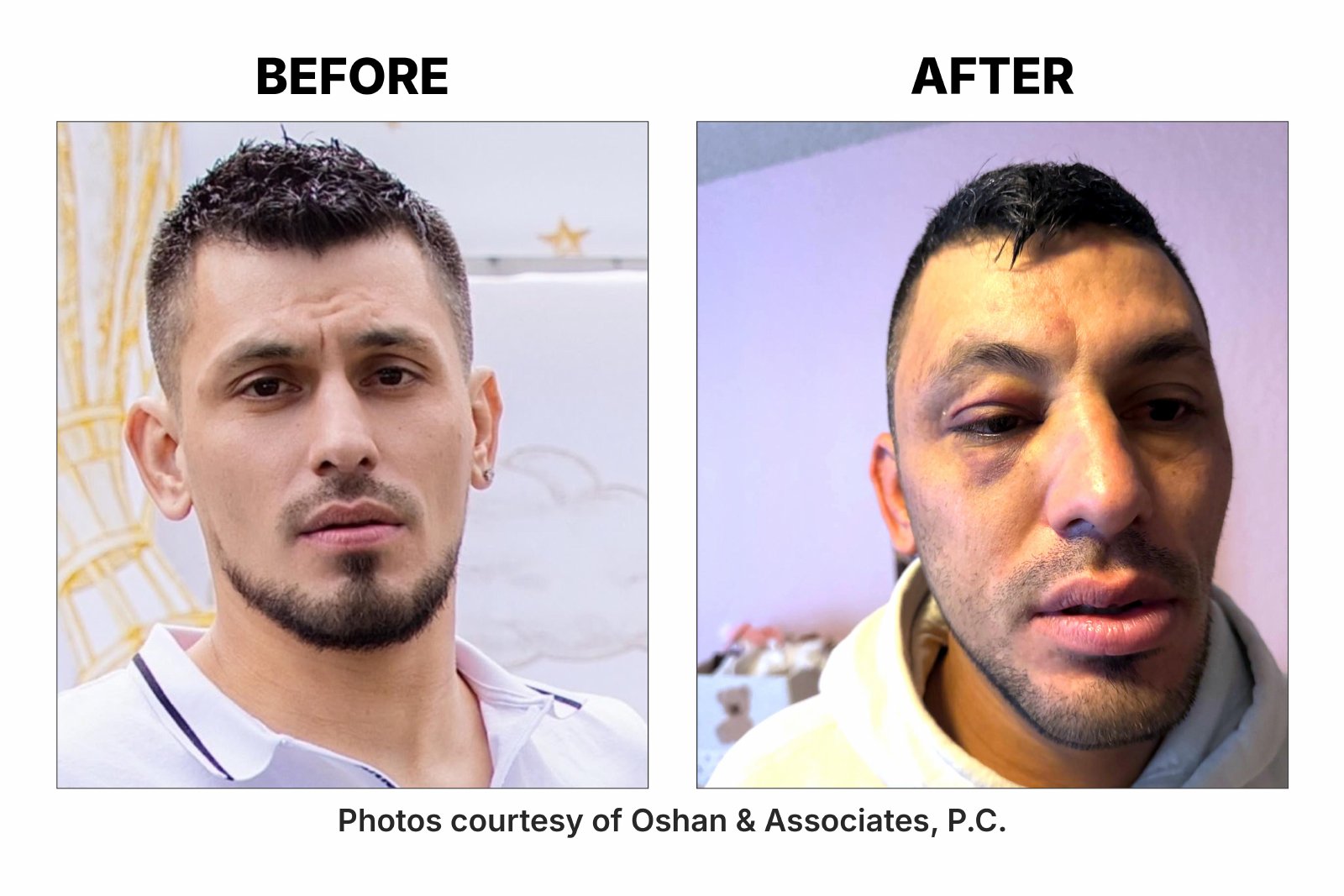
The Auburn Police Department first described his injuries as minor. Our firm has stated publicly that he suffered a mild traumatic brain injury and other injuries. Learn the signs of a brain injury.
Mauro Alberto Felix Valles before and after the October 28, 2026 arrest. Published with his permission.
Officer Bryant has been placed on administrative leave. The Renton Police Department is conducting an independent criminal review, and the City of Auburn has opened its own internal investigation into whether department policy was followed. Both reviews were ongoing at the time of this post.
01
Civil rights complaints
Filed with the Washington Attorney General’s Office and the U.S. Attorney’s Office.
02
Peace officer certification
The firm asked the Washington State Criminal Justice Training Commission to revoke Officer Bryant’s peace officer certification.
03
Call to resign
We have called on Officer Bryant to resign.
The state can suspend or revoke an officer’s certification for force that violates the law or department policy.
As Covered By
New York Post · The Seattle Times · KOMO News · KIRO 7 · FOX 13 Seattle · Auburn Reporter
What happened on Auburn Way North is on video, and the public has seen it. Mr. Felix Valles and his family want a full and honest accounting from every agency now reviewing it. We will keep pressing until they get one.
Background
Understanding police excessive force: general information about how police use of force is evaluated in Washington.
Police officers are allowed to use force in some situations, but the law places limits on how much force and when. Under the U.S. Constitution, the general question is whether the force was objectively reasonable in light of the circumstances the officer faced, such as how serious the situation was, whether the person posed a threat to anyone, and whether the person was resisting or trying to get away.
In recent years Washington has adopted statewide standards for police use of force. These laws emphasize de-escalation, call on officers to act with reasonable care, and require an officer who sees another officer using excessive force to step in when able to do so.
When an officer’s use of force is questioned, review can come from several directions:
Internal investigations
The officer’s own department reviews whether its policies were followed.
Independent criminal reviews
An outside agency or prosecutor may examine whether any criminal law was broken.
State certification
Washington’s Criminal Justice Training Commission certifies officers and can suspend or revoke certification.
Civil claims
People who were harmed may bring civil claims against the officer or the government agency involved.
Use of force incidents often turn on the evidence: body camera and dash camera footage, bystander video, photographs, medical records, and witness accounts. Recordings are not always kept indefinitely, and injuries such as concussions are not always obvious right away. Learn more about the signs of a brain injury.
A concussion is a brain injury. According to the Centers for Disease Control and Prevention (CDC), a mild traumatic brain injury (mTBI) or concussion is caused by a bump, blow, or jolt to the head or body that makes the head and brain move quickly back and forth. That movement can cause the brain to bounce or twist inside the skull, create chemical changes in the brain, and sometimes stretch and damage brain cells. Doctors may call these injuries “mild” because they are usually not life threatening, but the CDC notes that their effects can be serious. Assaults are among the leading causes of concussions seen in emergency departments.
Physical
• Headaches
• Dizziness or balance problems
• Nausea or vomiting (early on)
• Vision problems
• Bothered by light or noise
• Feeling tired, no energy
Thinking and Memory
• Trouble concentrating
• Feeling slowed down
• Feeling foggy or groggy
• Problems with short or long term memory
• Trouble thinking clearly
Emotional
• Irritability
• Sadness
• Anxiety or nervousness
• Feeling more emotional than usual
Sleep
• Sleeping more than usual
• Sleeping less than usual
• Trouble falling asleep
Symptoms are different for each person. Some appear right away, while others may not show up for hours or days, and symptoms can change during recovery. Most people feel better within a couple of weeks, but for some people symptoms last longer. Because concussion symptoms can look like other health problems, they can be overlooked by the injured person, their family, or even their healthcare provider.
CDC Danger Signs
The CDC advises calling 9-1-1 or going to an emergency department right away if, after a blow to the head or body, a person:
• Has a headache that gets worse and does not go away
• Has weakness, numbness, decreased coordination, convulsions, or seizures
• Vomits repeatedly
• Has slurred speech or unusual behavior
• Has one pupil larger than the other
• Cannot recognize people or places, or becomes confused, restless, or agitated
• Loses consciousness, looks very drowsy, or cannot be woken up
The CDC recommends that anyone with a possible concussion be seen by a healthcare provider. For more, see the CDC’s guide to mild TBI and concussion symptoms, our mild traumatic brain injury checklist, and our Seattle brain injury attorney page.
There is no single rule or number. Whether force was excessive depends on the full circumstances of the encounter, including what happened before, during, and after the force was used.
Depending on the incident, the officer’s own department, an outside law enforcement agency, prosecutors, and the state commission that certifies officers may all play a role.
Claims involving police officers and government agencies can carry strict deadlines and special filing requirements. Which ones apply depends on the situation, so it is best to speak with a lawyer early.
If you or someone you love was injured during an encounter with police, contact us today for a confidential consultation. Learn more about our Seattle personal injury lawyers.
Disclaimer
This article is provided for general informational purposes only and is not legal advice. Reading it, or contacting Oshan & Associates, P.C., does not create an attorney-client relationship. Every situation is different, and the law changes over time, so you should not act or rely on anything in this article without consulting a lawyer about your specific circumstances. Health information in this article is general, is drawn from the Centers for Disease Control and Prevention, and is not medical advice; anyone with a possible head injury should consult a healthcare provider.
Statements about the matter described in this article reflect publicly available information and the positions of our client as of the date of publication. Investigations and proceedings are ongoing, and no officer has been charged with a crime.
Attorney Advertising. Prior results do not guarantee a similar outcome.
Comments will be approved before showing up.
February 03, 2025
If you are injured in an accident caused by snow or ice conditions, it is essential to understand your legal rights. Seattle snow storm accident attorneys of Oshan & Associates, P.C. specialize in personal injury cases
January 11, 2025
December 22, 2024
Negligent Security in Washington State Bars: A Comprehensive Guide by Evan Oshan of Oshan & Associates, P.C. As an experienced personal injury attorney at Oshan & Associates, P.C., I have witnessed firsthand the devastating consequences that can arise from inadequate security in public venues, particularly bars.
The information provided on this website, including all blog posts, articles, and other content, is for informational purposes only and should not be construed as legal advice. No attorney-client relationship is formed by accessing or using this site or its contents.
Sign up to get the latest news on Washington state accidents, self help articles and more…
© 2026 Oshan & Associates, P.C.
We fight for the injured!