Personal Injury Law Firm in Seattle Washington. Free case evaluation (206) 206-6000

August 01, 2020
Updated November 2026
New York and Washington Scaffold Accident Guide
A scaffold that collapses, tips or has no railing can turn a routine job into a life-changing fall. New York's scaffold law puts the duty to provide safe scaffolding on property owners and contractors, and Washington holds general contractors responsible for safety rules across the whole job site. Here is what the rules require in both states, how a claim works, and what to do next.
Offices in New York and Seattle · Free, confidential consultation · No attorney fee unless we recover
65%
of construction workers work on scaffolds regularly, per OSHA
10 feet
OSHA fall protection threshold
7 feet
New York railing threshold
3 years
to file most injury lawsuits in New York and Washington
Sources: OSHA Scaffolding eTool, 29 CFR 1926.451, 12 NYCRR 23-5.1, CPLR 214, RCW 4.16.080.
Safety Basics
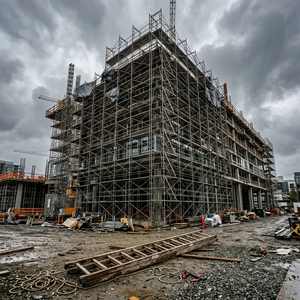
Each piece matters. A missing one can cause a fall.
According to OSHA, about 2.3 million construction workers, roughly 65 percent of the construction workforce, work on scaffolds regularly. Federal rule 29 CFR 1926.451 sets the basics for every one of them.
Each scaffold must support at least 4 times its maximum intended load. Supported scaffolds must rest on base plates and mud sills or another firm foundation, never on unstable objects, and every working platform must be fully planked or decked.
Workers more than 10 feet above a lower level must be protected from falling, and workers below must be protected from falling tools and debris. A competent person must inspect the scaffold for visible defects before each work shift and supervise its erection, moving and dismantling.
New York Law
New York's rules go further than OSHA's in several places.
Under Labor Law § 240(1), owners and contractors on building work must furnish scaffolding and other devices built, placed and operated to give proper protection to workers. Owners of one and two-family homes who contract for but do not direct or control the work are excluded.
New York's Industrial Code § 23-5.1 requires railings on the open sides of scaffold platforms more than 7 feet up, with limited exceptions, compared with OSHA's 10-foot fall protection line. Scaffolds must bear 4 times the maximum weight they will carry, planks must extend between 6 and 18 inches past end supports, and every scaffold must be erected and removed under a designated person's supervision.
A violation of a specific Industrial Code rule can also support a claim under Labor Law § 241(6). For ladder falls, see our ladder accident guide.
Common Causes
1
Open sides without guardrails are a leading way workers fall from platforms.
2
Scaffolds set on soft ground, bricks or boxes can shift, tip or collapse.
3
Too many workers or materials can exceed what the scaffold was built to hold.
4
Loose, short or missing planks give way under a worker's step.
5
Damaged parts and loose ties go unnoticed without a check each shift.
6
Tools and debris dropped from above can strike workers and passersby below.
New York Claims
Workers' compensation covers medical care and part of your lost wages without regard to fault, under Workers' Compensation Law § 10. It is usually the only remedy against your own employer, and it does not pay for pain and suffering.
A Labor Law claim against the property owner and general contractor can add what workers' compensation does not cover, including pain and suffering. You can pursue both at the same time under WCL § 29. A scaffold manufacturer or rental company may also be responsible if a defective part failed.
People who are not workers, such as pedestrians hit by falling debris, may have a negligence claim against the owner and contractors. New York's 2026 change to its comparative fault rule applies to car accident cases, not scaffold falls. For more, see our New York construction accident guide.
Washington Claims
Washington has no scaffold law like New York's Labor Law § 240(1). Instead, scaffold safety on Washington job sites is governed by the state's own safety rules, chapter 296-874 WAC, enforced by the Department of Labor and Industries, which cover scaffold loading, inspection, fall protection and falling object protection.
Washington general contractors carry a broad duty. In Stute v. P.B.M.C., Inc., 114 Wn.2d 454 (1990), the Washington Supreme Court held that a general contractor must comply with state safety regulations for every worker on the job site, including employees of subcontractors, and should bear the primary responsibility for compliance. That case involved a subcontractor's employee who fell from a roof with no safety devices in place.
Workers' compensation is generally the only remedy against your own employer under RCW 51.04.010, but you may bring a claim against a general contractor, property owner or other company that is not your employer under RCW 51.24.030. File your workers' compensation claim within one year under RCW 51.28.050, and most injury lawsuits within three years under RCW 4.16.080. If you were partly at fault, Washington reduces your recovery by your share of fault rather than barring it, under RCW 4.22.005.
Self-Help Tool
Tap each box as you go. Scaffolds are often changed or taken down quickly, so photos matter.
Questions
Under Labor Law § 240(1), owners and contractors on building work must furnish scaffolding that gives proper protection to workers. Owners of one and two-family homes who do not direct or control the work are excluded.
New York's Industrial Code § 23-5.1(j) requires railings on the open sides of scaffold platforms, with exceptions that include platforms not more than 7 feet up. Federal OSHA requires fall protection for workers more than 10 feet above a lower level.
Usually you cannot sue your own employer, but you can collect workers' compensation and bring a Labor Law or negligence claim against the owner, general contractor or another responsible party at the same time.
Washington has no statute like New York's Labor Law § 240(1). But under Stute v. P.B.M.C., Inc., 114 Wn.2d 454 (1990), Washington general contractors must comply with state safety regulations for every worker on the job site, including subcontractors' employees, and you may bring a claim against them in addition to workers' compensation.
Give your employer written notice within 30 days and file a workers' compensation claim within 2 years. Most personal injury lawsuits must be filed within 3 years under CPLR 214.
File a workers' compensation claim within one year under RCW 51.28.050. Most personal injury lawsuits must be filed within three years under RCW 4.16.080.
The consultation is free and confidential, and you pay no attorney fee unless we recover compensation for you.
Oshan & Associates, P.C. represents injured people and families in Washington and New York. The consultation is free and confidential, and you pay no attorney fee unless we recover compensation for you.
Call (206) 206-6000Learn More
Falls from scaffolds, ladders and roofs.
Injuries with lifelong medical and care costs.
Paralysis and spinal injuries from accidents.
Claims for families who lost a loved one.
This guide gives general information and is not legal advice. Rules and statistics were checked against official sources in November 2026.
Comments will be approved before showing up.
November 26, 2026
How long before you can work after a concussion, how to plan a gradual return, warning signs to watch for and what Washington workers should know about lost wages.
November 24, 2026
Hurt in a crane accident in Washington? Learn how load charts and rated capacity work, why rigging fails, crane operator certification rules, and how injured workers can recover beyond workers' compensation.
November 23, 2026
When concussion symptoms last for months, timing and proof matter. What post-concussive syndrome means for an injury claim in Washington, and why you should not settle too soon.
Seattle Practice Areas
Personal Injury
Car Accident
Semi Truck Accident
Bus Accident
Motorcycle Accident
Pedestrian Accident
Brain Injury
Spinal Cord Injury
Catastrophic Injury
Wrongful Death
Loss of Consortium
Childhood Sexual Abuse
Bicycle Accident
Police Excessive Force
911 Response Failure
Uber & Lyft Accident
Uninsured Motorist
Dog Bite
Drunk Driver Crash
Delivery Truck
Premises Liability
Burn Injury
Scooter & E-Bike
Light Rail & Train
Kent Practice Areas
Auburn Practice Areas
Bellevue Practice Areas
Renton Practice Areas
Federal Way Practice Areas
Kirkland Practice Areas
Redmond Practice Areas
Burien Practice Areas
SeaTac & Tukwila Practice Areas
Shoreline Practice Areas
Tacoma Practice Areas
The information provided on this website, including all blog posts, articles, and other content, is for informational purposes only and should not be construed as legal advice. No attorney-client relationship is formed by accessing or using this site or its contents.